Monday, June 2, 2014

Zappos Insider: The Death of Job Postings and the Rise of the Borg

As set out in a prior post, Zappos has launched a new careers site and removed all job postings. Instead of applying for jobs, persons interested in working at Zappos will need to enroll in a social network run by the company, called Zappos Insiders. The social network will allow them to network with current employees by digital Q&As, contests and other means in hopes that Zappos will tap them when jobs come open.

"Zappos Insiders will have unique access to content, Google Hangouts, and discussions with recruiters and hiring teams. Since the call-to-action is to become an Insider versus applying for a specific opening, we will capture more people with a variety of skill sets that we can pipeline for current or future openings," said Michael Bailen, Zappos’ head of talent acquisition.

The idea, in part, is that recruiters will monitor the interactions, and alert promising applicants as job positions become available. "Our recruiters are focusing on proactive sourcing…so that we know EXACTLY who we want to interview once a position becomes available," Stacy Donovan Zapar, Zappos' Social Recruiting and Employer Branding Strategist, wrote in a posting  (Big News: The Day the Posting Died) explaining Zappos Insiders.

We are the Borg. You will be assimilated.

For those not Star Trek fans, Borgs are beings that are part organic and part artificial. They assimilate almost everyone they come in contact with into the Borg - a mass consciousness - and those persons become efficient drones who do not even remember their old life. A quote from one of the episodes:
"We are the Borg. Lower your shields and surrender your ships. We will add your biological and technological distinctiveness to our own. Your culture will adapt to service us. Resistance is futile.”
Assimilation by the Borg and the Zappos Insider program seem to have some potentially troubling similarities (though one might suggest that a Zappos Borg might be able to really "Deliver WOW Through Service" - Zappos' first core value ...). Zappos' gathering of personal information/borg assimilation process starts with a person's becoming a member of Zappos Insider. For example, a person may sign up to be a Zappos Insider by linking to their FaceBook or LinkedIn accounts. If signing in using a LinkedIn account, you are asked to allow Zappos the following accesses:
  • Your full profile
  • Your email address
  • Your connections
  • Your contact info
  • Invitations and messages
  • Company pages
If signing in using a Facebook account, you are asked to allow Zappos the following access:

  • Your public profile
  • Your friend list
  • Your email address
  • Your News Feed
  • Your friends' likes
Once a person becomes an Insider, the information collection/borg assimilation process continues as Zappos tracks and records Insiders' interactions with the company - from discussions with recruiters and hiring teams, to Google Hangout participation, conversations with Zappos "ambassadors," to digital Q&As, to contests, etc. 

Borg Assimilation: All Good, Right?

On March 12, 2014, a panel of experts addressed the EEOC at a meeting held at EEOC headquarters in Washington and discussed the growing use of social media and how it impacts the laws the EEOC enforces. In her testimony at the meeting, one of the experts, Lynne Bernabei, Esq. stated:

Surveys of hiring managers show that they are increasingly using social media to screen job candidates, and that employers may make a determination on an employee's suitability for a job opening based on the content of his or her social networking website. However, social media websites also display "non-job-relevant information that could be used inappropriately for evaluating applicants, resulting in biased hiring decisions," and "the potential for legal liability is great, considering the dearth of research regarding whether [social network-] derived information validly predicts job performance." ... Marital status, family and childcare obligations, home location (and therefore length of commute), and even sports team affiliation may directly or indirectly affect an employer's willingness to hire a given candidate-and all of this information is easily accessible on Facebook.

In response to a March 25, 2012 letter from Senator Charles E. Schumer and Senator Richard Blumenthal, the EEOC stated that covered employers - like Zappos - may not use personal information from social networks to make employment decisions on a prohibited basis, be it race, color, religion, national origin, sex, age, disability, or protected genetic information. 

For example, the letter explained, rejecting an applicant because he is Muslim, as disclosed through social media postings, would violate Title VII of the Civil Rights Act of 1964, as amended (Title VII). Similarly, rejecting an individual with a family history of breast cancer, as shown in the caption to a photo of her completing the "Race for the Cure" in memory of her sister "who lost her battle with this horrible disease," would violate the Genetic Information Nondiscrimination Act (GINA). Finally, screening out an applicant because her Facebook page has photos of her 50th birthday celebration, would violate the Age Discrimination in Employment Act (ADEA).

The EEOC's May 2012 response to Senators Schumer and Blumenthal also discussed another important topic: pre-employment inquiries about protected status. The laws enforced by the EEOC have differing approaches to this issue. Title VII and the ADEA do not explicitly prohibit questions about race, gender, national origin, religion, or age 40 or above, but if an EEOC investigation shows that an employer inquired about these matters (for example, by viewing Facebook or LinkedIn profiles and profile pictures), the EEOC will assume that the employer considered the information relevant to its employment decision and will scrutinize the facts closely. By contrast, GINA and Title I of the Americans with Disabilities Act (ADA) explicitly provide that making a pre-employment disability-related inquiry, or requesting or requiring genetic information, constitute independent statutory violations subject to certain conditions and exceptions

Anything Particularly Problematic?

RenĂ©e Jackson, Esq., a lawyer who led the Social Media & Technology in the Workplace team within the Labor and Employment practice group at Nixon Peabody LLP, was one of the experts testifying at the March 12, 2014 EEOC meeting mentioned previously. Nixon Peabody LLP counsels employers and their clients range greatly-in size, location, and industry. 

A portion of Ms. Jackson's testimony is set out below, the portions of her testimony that may prove challenging for Zappos and the Zappos Insider program are highlighted in red. Advice from Ms. Jackson that may be particularly problematic for Zappos Insider are bolded:

I advise employers wishing to supplement traditional hiring practices with social media to consider the following options for compliance:
  • Use social media as part of a larger recruitment plan, including both traditional and new media, in-person networking events, job fairs, and referrals.
  • Have a third-party consumer reporting agency or a designated individual within the company (who does not make hiring decisions) conduct the social media background check and filter out any protected class information.
  • When using social media information during the hiring process, confirm that the information obtained was actually created by or relates to the applicant (as opposed to someone else with the same name), and disregard any information that cannot be confirmed as accurate.
  • Only review publicly available information about an applicant. Do not request usernames/passwords or otherwise try to gain access to non-public or password-protected social media.
  • If possible, screen all applicants in a uniform and consistent manner. Have human resources conduct the search at the same stage of the hiring process for each candidate (before the offer of employment, for example), rather than have hiring managers randomly conducting searches on their own.
  • Avoid recruiting solely from social media or limiting applicants to applying only through social media or only with their social media profile.
  • Avoid making hiring decisions based on an applicant's lack of a social media presence, unless a social media presence is required for the position (e.g., employer is hiring a social media manager for the company).
  • Make sure those responsible for hiring know the applicable protected classes (federal, state, and local). Train all supervisors and HR professionals on how to lawfully use social media during recruiting and hiring. Support all hiring decisions with legitimate, non-discriminatory reason(s) and documentation.

Ms. Jackson closed her testimony noting, “Employers must understand that the technology will always outpace the law and, as a result, employment policies and practices must be constantly revisited and updated accordingly. On the flip side, however, many of the employment law concepts that employers are already familiar with can be applied and should not be forgotten just because the spaces are new.”


Michael Bailen, who heads talent acquisition for Zappos, told the Wall Street Journal that he is surprised that Zappos appears to be the first to drop job listings. “We’re hoping a lot of other companies jump on board,” he said. For reasons set out in this and two prior posts (Zappos Hiring: Culturally Fit? Legally Defensible? and Zappos: The Future of Hiring and Hiring Discrimnation), Zappos may find other employers unwilling to adopt this practice. 


Zappos: The Future of Hiring and Hiring Discrimination?

Zappos has launched a new careers site and removed all job postings. Instead of applying for jobs, persons interested in working at Zappos will need to enroll in a social network run by the company, called Zappos Insiders. The social network will allow them to network with current employees by digital Q&As, contests and other means in hopes that Zappos will tap them when jobs come open.

"Zappos Insiders will have unique access to content, Google Hangouts, and discussions with recruiters and hiring teams. Since the call-to-action is to become an Insider versus applying for a specific opening, we will capture more people with a variety of skill sets that we can pipeline for current or future openings," said Michael Bailen, Zappos’ head of talent acquisition.

The idea is that recruiters will monitor the interactions, and alert promising applicants as job positions become available. "Our recruiters are focusing on proactive sourcing…so that we know EXACTLY who we want to interview once a position becomes available," Stacy Donovan Zapar, Zappos' Social Recruiting and Employer Branding Strategist, wrote in a posting explaining Zappos Insiders.

Ideally, the Zappos Insider strategy will result in an engaged, talented applicant pool from which the company can seamlessly fill positions. More importantly, at a company where cultural fit is 50 percent of the hiring equation, encouraging candidates and current employees to interact organically allows the company to gauge whether someone is a good fit before the hiring process officially begins, theoretically saving both time and money.

Zappos’ Bailen said he is surprised that Zappos appears to be the first to drop job listings. "We're hoping a lot of other companies jump on board," he said, but there are compelling reasons why Zappos may find itself alone.

Bias and Discrimination

In a comment to Donovan Zapar’s posting explaining the Zappos Insider initiative, Steve Kuzner asked:
Ultimately, the [Zappos Insider] policy makes the hiring process less transparent for job seekers, who will no longer even know there is an open position until they are deemed worthy to apply for it. While well-intentioned, such opacity provides a shield under which bias, conscious or not, can potentially flourish.
Donovan Zapar responded, in part, by acknowledging that there are laws prohibiting an employer from basing hiring decisions on the race, religion, national origin, gender, pregnancy, disability, genetic identity, or age of applicants (Protected Persons). That response is correct, as far as it goes, but it fails to address the broad scope of Title VII of the Civil Rights Act of 1964 (Title VII), its progeny (Age Discrimination in Employment Act (ADEA), Americans with Disabilities Act (ADA), Genetic Information Non-Discrimination Act (GINA), etc.), their implementing regulations, and court decisions over the past fifty years.

In addition to prohibiting discrimination in hiring, employment laws prohibit discrimination against Protected Persons in regard to recruiting, the work environment, or any other term, condition, or privilege of employment.  Not only do the laws prohibit intentional discrimination, they also prohibit neutral policies that disproportionately affect Protected Persons and that are not related to the job and the needs of the business.

Job requirements must be uniformly and consistently applied to all persons. Even if a job requirement is applied consistently, if it is not important for job performance or business needs, the requirement may be found unlawful if it excludes Protected Persons significantly more than others. Examples of potentially unlawful practices include: (1) soliciting applications only from sources in which all or most potential workers are of the same race or color; (2) requiring applicants to have a certain educational background that is not important for job performance or business needs; and, (3) testing applicants for knowledge, skills or abilities that are not important for job performance or business needs.

[Dis]Connection

Donovan Zapa wrote in her post:
In preparation for this day, we've built a brand new "Inside Zappos" social recruiting presence over the past couple of months on Twitter, Facebook, Instagram, LinkedIn and Pinterest …. We've used these social channels to share our company culture, our people, our campus, our events, the way we do business and also to get to know the people who might like to work for us someday.
Similarly, in response to the question, “How can I stand out from the pack and stay front-and-center in the Zappos Recruiters’ minds?” on the Zappos' Insider site, the company lists six ways to stand out, including: using Twitter, Facebook, Instagram, Pinterest and Google Hangouts; participating in TweetChats; following Zappos’ employees on various social media platforms; and, reaching out to Zappos’  “team ambassadors.” For the most part, all of the foregoing activities require broadband internet access and devices (tablets, smartphones, etc.) that run on those access networks.  A number of Protected Classes will be challenged by both the broadband access and social media participation requirements:
  • As noted  by a PewResearch Internet Project Research report, African Americans have long been less likely than whites to have high speed broadband access at home, and that continues to be the case. Today, African Americans trail whites by seven percentage points when it comes to overall internet use (87% of whites and 80% of blacks are internet users), and by twelve percentage points when it comes to home broadband adoption (74% of whites and 62% of blacks have some sort of broadband connection at home).  
  • The gap between whites and blacks when it comes to traditional measures of internet and broadband adoption is pronounced. Specifically, older African Americans, as well as those who have not attended college, are significantly less likely to go online or to have broadband service at home compared to whites with a similar demographic profile.
  • According to the PewResearch Internet Project, even among those persons who have broadband access, the percentage of those using social media sites varies significantly by age:

Age
Social Media Participation
18-29
90%
30-49
78%
50-64
65%

Social medial participation is not solely a function of age. "Social media is transforming how we engage with customers, employees, jobseekers and other stakeholders," said Kathy Martinez, Assistant Secretary of Labor for Disability Employment Policy. "But when social media is inaccessible to people with disabilities, it excludes a sizeable segment of our population." Persons with disabilities (e.g., sight or hearing loss, paralysis), whether physical, mental, or developmental, face challenges accessing social media. Each of the social media platforms promoted by Zappos - Twitter, Facebook, Instagram, Pinterest, and Google Hangouts - have differing levels of support for those with disabilities (e.g., close captions or real live captions on image content that utilize sound/voice). 

Career transition and talent development consulting firm Lee Hecht Harrison asked hundreds of job seekers via an online poll, “How active are you on social networking sites?” Only forty-eight percent said they're active on a daily basis, with an additional nineteen percent saying they log on about two or three times per week. This leaves thirty-three percent who use social media sites one to three times a month, if at all. 
As Aristotle wrote, “There is nothing so unequal as the equal treatment of unequals.” It is for this reason that employment laws like Title VII prohibit facially neutral policies (e.g.,  enrolling in Zappos Insider, necessitating broadband internet access, and using social media platforms with varying degrees of accessibility ) that disproportionately affect Protected Persons and that are not related to the job and the needs of the business. Zappos' Insider may be a club that is "open" to everyone, but African Americans, persons over forty, and persons with disabilities, among others, will have a harder time being admitted and will be limited in their ability to use all the club has to offer.

Donovan Zapa, in her posting announcing Zappos' Insider, wrote:
[O]ur recruiters are focusing on proactive sourcing, driving people to join our Insider program, having two-way conversations, meeting people, networking, chatting with Insiders, answering questions, engaging on social media, employer branding and proactive pipelining so that we know EXACTLY who we want to interview once a position becomes available. It's old-school recruiting, made new and fresh again. 
It is likely that "old school recruiting" was part of the reason that laws like Title VII, ADEA, ADA and GINA were enacted. Persons making hiring decisions knew exactly who they wanted to interview and that did not include persons of color, women, older Americans, persons with disabilities, and persons of certain faiths. While likely not the intent, Zappos' Insider platform makes discrimination against "those persons" new and fresh (and painful and illegal) again.


Saturday, May 31, 2014

Zappos Hiring: Culturally Fit? Legally Defensible?

Zappos has two separate sets of interviews. The hiring manager and his or her team will interview for the standard fit within the team, relevant experience, technical ability and so on. And then the HR department does a separate set of interviews purely for culture fit. Zappos has questions for each and every one of their ten core values. "They [applicants] need the relevant skill set and experience and so on," CEO Tony Hsieh says. "But far more important is, are they going to be good for the culture? Is this someone we would choose to have dinner or drinks with, even if they weren't working for Zappos?"

One of Zappos' core values is, "Create fun and a little weirdness." So, during an interview, a candidate gets asked, "On a scale of 1 to 10, how weird are you?"  "If you're a 1, you're probably a little bit too strait-laced for us. If you're a 10, you might be too psychotic for us," says Hsieh.  Another potential deal-breaker is saying you don’t socialize with co-workers outside the office. That could undermine another of Zappos’ core values: “Build a positive team and family spirit.”

Michael Hyter, senior partner at Korn Ferry has states, “The word ‘‘fit’’ in the absence of that support factor [fair consideration for jobs for people who happen to be different] can easily be misinterpreted as ‘‘being like me,’’ instead of what the position requires. Many organizations make the mistake of assuming that those tasked with selecting new hires are equipped to do so fairly because they are nice people or good workers. But failure to ensure the selection process is based on standard criteria with trained interviewers can result in unintentional bias in the spirit of looking for someone who’s a perceived ‘‘good fit.’’

Built-In Headwinds

As Natasha Tiku wrote in ValleyWag, "Taken at face value, "not a culture fit" sings: Nothing personal, you'd probably be happier somewhere else! But what prioritizing "fit" really allows a company to do is reject an applicant for not matching the pattern. For being an "other" in some way. For coming from a different background, looking different, acting different, having different interests, all of which should be considered an asset.

More than forty years ago, the Supreme Court ruled in Griggs v Duke Power Co. that "good intent or absence of discriminatory intent does not redeem employment procedures or testing mechanisms that operate as “built-in headwinds” for minority groups and are unrelated to measuring job capability." The Court found that some of Duke’s hiring requirements, like a high school education or a certain I.Q. level, were irrelevant to some jobs and had the effect of excluding qualified black workers. The Court held that the law "proscribes not only overt discrimination but also practices that are fair in form, but discriminatory in operation. The touchstone is business necessity. If an employment practice which operates to exclude Negroes cannot be shown to be related to job performance, the practice is prohibited."

As previously noted, failing to socialize with co-workers outside the office is a potential deal-breaker for Zappos. According to the company, that could undermine one of its core values: “Build a positive team and family spirit.”  This out-of-office socializing "deal-breaker" eliminates many persons from employment consideration, including single parents, children whose elderly parents need care, persons going to school part-time, and well-rounded persons who have interests outside the company - persons who engage in charitable activities, participate in civic functions or practice their faith.

A frequently-mentioned aspect of the Zappos culture involves the consumption of alcohol:
  • According to Business Insider, "Zappos prides itself on a fun, quirky company culture where the CEO Tony Hsieh has been known to dole out shots of Grey Goose."
  • A Zappos press release reads, "I had three vodka shots with Tony during my interview," says Rebecca Ratner, Zappos's head of human resources. "And I'm not atypical."
  • As Ms. Ratner stated, "While we rack up some pretty big bills for happy hours and parties, we believe that every one of those dollars comes back to us threefold in employee engagement, which to us is really what success is all about."
The prominent role alcohol plays in Zappos' hiring for "cultural fit" would seem to present built-in headwinds for Mormons, Baptists, Muslims, recovering alcoholics, diabetics, and persons scarred - physically or mentally - by the acts and actions of alcoholics. As noted in Zappos: The Future of Hiring and Hiring Discrimination, many of the persons experiencing those headwinds are Protected Persons under federal and state employment discrimination laws.

During an interview at Zappos, a candidate gets asked, "On a scale of 1 to 10, how weird are you?" According to Zappos' CEO, "If you're a 10, you might be too psychotic for us." In a company that has "Create Fun and a Little Weirdness" as one of its core values, the word "weird" is associated with mental illness.

Historically, many employers asked applicants to provide information concerning their physical and/or mental condition. This information often was used to exclude and otherwise discriminate against individuals with disabilities -- particularly nonvisible disabilities, such as mental illness -- despite their ability to perform the job.The Americans with Disabilities Act (ADA) prohibits all disability-related inquiries pre-job offer.

The use of tests and other selection procedures, like Zappos' cultural fit interview, can violate the ADA if an employer intentionally uses them to discriminate based on disability or if they disproportionately exclude persons with disabilities, like persons with mental illness.

EEOC guidance notes that employers should ensure that employment tests and other selection procedures are properly validated for the positions and purposes for which they are used. The test or selection procedure must be job-related and its results appropriate for the employer’s purpose. If a selection procedure screens out a protected group (i.e., race, gender, age, disability), the employer should determine whether there is an equally effective alternative selection procedure that has less adverse impact and, if so, adopt the alternative procedure.

Core Values and Transparency

Zappos established ten core values to clearly define the Zappos Family culture, values that are to be reflected in everything they do and every interaction they have. When searching for potential employees, Zappos looks for people who both understand the need for these core values and are willing to embrace and embody them. The ten core values are explained by Zappos employees in the following video:


With the exception of the CEO, there appear to be no persons of color among the seven employees interviewed in the video. It may well be that the video is not a representative sampling of employee diversity at Zappos and, if so, the company, acting in accordance with the core value “Build Open and Honest Relationships With Communication,” could publish information on its workforce diversity along the lines of Google's recent disclosure. As Google's Senior Vice President of People Operations wrote:
We've always been reluctant to publish numbers about the diversity of our workforce at Google. We now realize we were wrong, and that it’s time to be candid about the issues. Put simply, Google is not where we want to be when it comes to diversity, and it’s hard to address these kinds of challenges if you’re not prepared to discuss them openly, and with the facts. 
The same spirit of openness that leads Zappos to supply information on sales to its suppliers through its extranet should lead it to provide its workforce diversity information to its employees, applicants, and the general public - Zappos' customers. 

Monday, May 19, 2014

EEOC's Next Step in Preserving Values

The recent White House report, “Big Data: Seizing Opportunities, Preserving Values," found that, "while big data can be used for great social good, it can also be used in ways that perpetrate social harms or render outcomes that have inequitable impacts, even when discrimination is not intended." The fact sheet accompanying the White House report warns:
As more decisions about our commercial and personal lives are determined by algorithms and automated processes, we must pay careful attention that big data does not systematically disadvantage certain groups, whether inadvertently or intentionally. We must prevent new modes of discrimination that some uses of big data may enable, particularly with regard to longstanding civil rights protections in housing, employment, and credit.

In order to address the potential for big data analytics to systematically disadvantage certain groups, the White House report contains the following policy recommendation:
The federal government’s lead civil rights and consumer protection agencies, including the Department of Justice, the Federal Trade Commission, the Consumer Financial Protection Bureau, and the Equal Employment Opportunity Commission, should expand their technical expertise to be able to identify practices and outcomes facilitated by big data analytics that have a discriminatory impact on protected classes, and develop a plan for investigating and resolving violations of law in such cases. In assessing the potential concerns to address, the agencies may consider the classes of data, contexts of collection, and segments of the population that warrant particular attention, including for example genomic information or information about people with disabilities. 
Examples of Discriminatory Big Data Practices and Outcomes

Examples of practices and outcomes facilitated by big data analytics that could have a discriminatory impact on protected classes include:


EEOC's Next Step?

The White House report recommends that the EEOC, as one of the federal government's lead civil rights agencies, expand its technical expertise to be able to identify practices and outcomes facilitated by big data analytics that have a discriminatory impact on protected classes. The EEOC's next step may be to call on some of the same resources used by the White House review group led by John Podesta at the three workshops held during the 90-day review period leading to the issuance of the White House report:
The suggestion is that some of the individuals and organizations that co-hosted, presented and supported those the three workshops be persuaded to take their shows on the road, assisting the EEOC and the other federal civil rights agencies (Department of Justice, Federal Trade Commission and Consumer Financial Protection Bureau)  in understanding and preventing new modes of discrimination that some uses of big data may enable, particularly with regard to housing, employment, and credit.


Thursday, May 15, 2014

White House: Big Data's Role in Employment Discrimination

In“Big Data: Seizing Opportunities, Preserving Values," a White House review of how the government and private sector use large sets of data found that such information could be used to discriminate against Americans on issues such as employment. As noted in the review, "while big data can be used for great social good, it can also be used in ways that perpetrate social harms or render outcomes that have inequitable impacts, even when discrimination is not intended."

Clear Windshield or Rearview Mirror?


Algorithms embody a profound deference to precedent; they draw on the past to act on (and enact) the future. The apparent omniscience of big data may in truth be nothing more than misdirection. Instead of offering a clear windshield, the big data phenomenon may be more like a big rear-view mirror telling us nothing about the future.

Does this deference to precedent result in a self-reinforcing and self-perpetuating system, where individuals are burdened by a history that they are encouraged to repeat and from which they are unable to escape?

Already burdened segments of the population can become further victimized through the use of sophisticated algorithms in support of the identification, classification, segmentation, and targeting of individuals as members of analytically constructed groups. In creating these groups, the algorithms rely upon correlations that lead to viewing people as members of populations, or categories, or groups, rather than as individuals (i.e., persons who live more than X miles from an employer's location). Please see From What Distance is Discrimination Acceptable?

Just as neighborhoods can serve as a proxy for racial or ethnic identity, there are new worries that big data technologies could be used to “digitally redline” unwanted groups, either as customers, employees, tenants, or recipients of credit. A significant finding of the White House report is that big data could enable new forms of discrimination.

Correlation Does Not Equal Causation

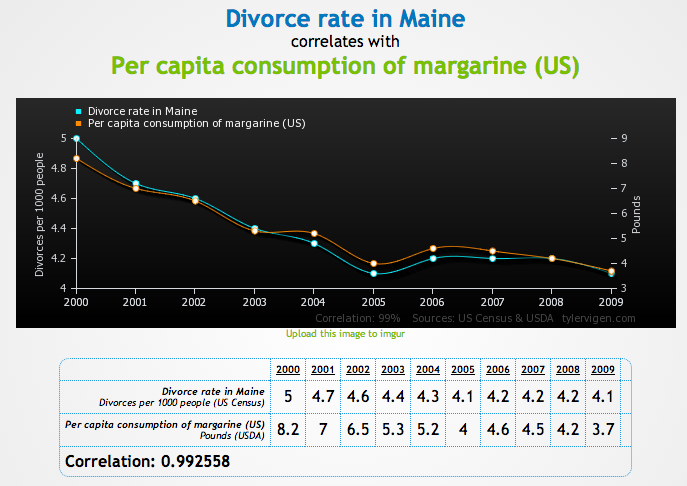
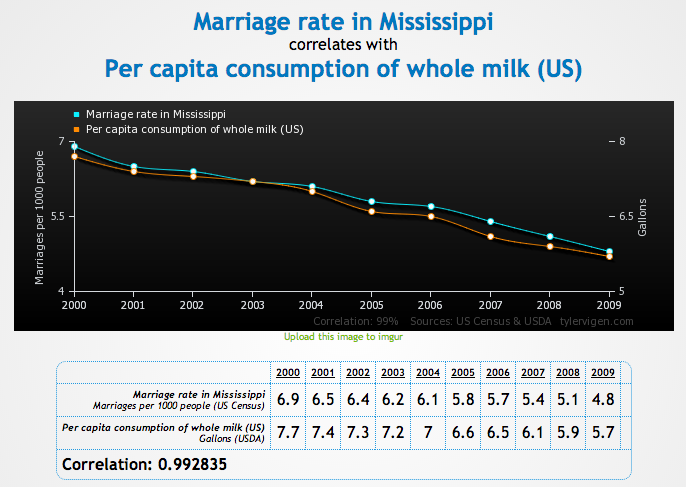
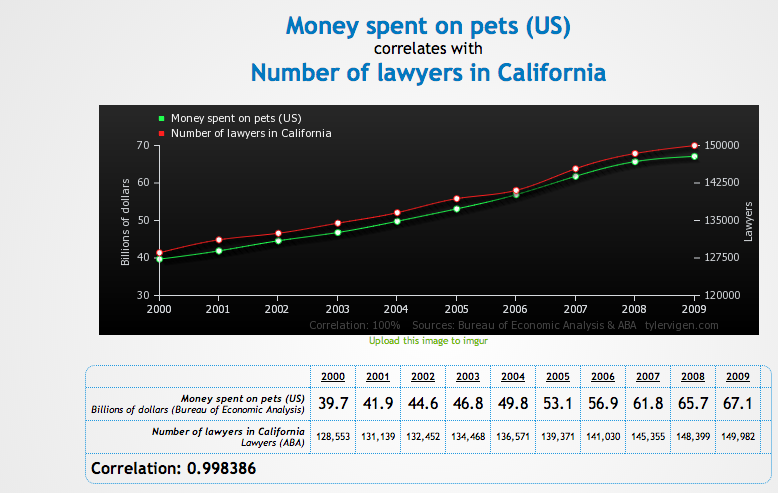
Decisions made or affected by correlation are inherently flawed. Correlation does not equal causation. This point is made vividly by Tyler Vigen, a law student at Harvard who, in his spare time, put together a website that finds very, very high correlations - as shown below - between things that are absolutely not related.

Screenshot_2014-05-12_12.46.40
Screenshot_2014-05-12_12.46.30
Screenshot_2014-05-12_12.45.09
Each of these have correlation coefficents in excess of 0.99, serving to demonstrate the point that a strong correlation isn't nearly enough to make strong conclusions about how two phenomena are related to each other.

Shrouding Opacity In The Guise of Legitimacy

Some of the most profound challenges revealed by the White House Report concern how big data analytics may lead to disparate inequitable treatment, particularly of disadvantaged groups, or create such an opaque decision-making environment that individual autonomy is lost in an impenetrable set of algorithms.

Workforce analytic systems, designed in part to mitigate risks for employers, have become sources of material risk, both to job applicants and employers. The systems create the perception of stability through probabilistic reasoning and the experience of accuracy, reliability, and comprehensiveness through automation and presentation. But in so doing, technology systems draw  attention away from uncertainty and partiality. Please see Workforce Science: A Critical Look at Big Data and the Selection and Management of Employees.

Moreover, they shroud opacity—and the challenges for oversight that opacity presents—in the guise of legitimacy, providing the allure of shortcuts and safe harbors for actors both challenged by resource constraints and desperate for acceptable means to demonstrate compliance with legal mandates and market expectations.

Programming and mathematical idiom (e.g., correlations) can shield layers of embedded assumptions from higher level decisionmakers at an employer who are charged with meaningful oversight and can mask important concerns with a veneer of transparency.

This problem is compounded in the case of regulators outside the firm, who frequently lack the resources or vantage to peer inside buried decision processes. In recognition of this problem, the White House Report states that "[t]he federal government must pay attention to the potential for big data technologies to facilitate discrimination inconsistent with the country’s laws and values" and, as one of the six policy recommendations in the report, :
The federal government’s lead civil rights and consumer protection agencies, including the Department of Justice, the Federal Trade Commission, the Consumer Financial Protection Bureau, and the Equal Employment Opportunity Commission, should expand their technical expertise to be able to identify practices and outcomes facilitated by big data analytics that have a discriminatory impact on protected classes, and develop a plan for investigating and resolving violations of law in such cases. In assessing the potential concerns to address, the agencies may consider the classes of data, contexts of collection, and segments of the population that warrant particular attention, including for example genomic information or information about people with disabilities. 

Thursday, May 1, 2014

Big Data: Seizing Opportunities, Preserving Values (Excerpted)

A White House review of how the government and private sector use large sets of data has found that such information could be used to discriminate against Americans on issues such as employment. Findings and recommendations of the review, “Big Data: Seizing Opportunities, Preserving Values," were released today (May 1, 2014). The report is the culmination of a 90-day review by the Obama administration, spearheaded by Counselor John Podesta and including the two Cabinet members - Penny Pritzker (Secretary of Commerce) and Ernest J. Moniz (Secretary of Energy). 


Excerpts from the report relating to big data analytics and employment discrimination follow, along with their location in the report:
A significant finding of this report is that big data analytics have the potential to eclipse longstanding civil rights protections in how personal information is used in housing, credit, employment, health, education, and the marketplace. Americans’ relationship with data should expand, not diminish, their opportunities and potential.  (cover letter to President Obama)
Some of the most profound challenges revealed during this review concern how big data analytics may lead to disparate inequitable treatment, particularly of disadvantaged groups, or create such an opaque decision-making environment that individual autonomy is lost in an impenetrable set of algorithms.  (p. 10)
Regardless of technological advances, the American public retains the power to structure the policies and laws that govern the use of new technologies in a way that protects foundational values. 
Big data is changing the world. But it is not changing Americans’ belief in the value of protecting personal privacy, of ensuring fairness, or of preventing discrimination.  (p. 10)

[T]he civil rights community is concerned that such algorithmic decisions raise the specter of “redlining” in the digital economy—the potential to discriminate against the most vulnerable classes of our society under the guise of neutral algorithms.  (p. 46) 
An important conclusion of this study is that big data technologies can cause societal harms beyond damages to privacy, such as discrimination against individuals and groups. This discrimination can be the inadvertent outcome of the way big data technologies are structured and used. It can also be the result of intent to prey on vulnerable classes.  (p. 51) 
We have taken considerable steps as a society to mandate fairness in specific domains, including employment, credit, insurance, health, housing, and education. Existing legislative and regulatory protections govern how personal data can be used in each of these contexts. Though predictive algorithms are permitted to be used in certain ways, the data that goes into them and the decisions made with their assistance are subject to some degree of transparency, correction, and means of redress. For important decisions like employment, credit, and insurance, consumers have a right to learn why a decision was made against them and what information was used to make it, and to correct the underlying information if it is in error.  
Just as neighborhoods can serve as a proxy for racial or ethnic identity, there are new worries that big data technologies could be used to “digitally redline” unwanted groups, either as customers, employees, tenants, or recipients of credit. A significant finding of this report is that big data could enable new forms of discrimination and predatory practices. 
Whether big data will build greater equality for all Americans or exacerbate existing inequalities depends entirely on how its technologies are applied in the years to come, what kinds of protections are present in the law, and how the law is enforced. (p. 53)

Putting greater emphasis on a responsible use framework has many potential advantages. It shifts the responsibility from the individual, who is not well equipped to understand or contest consent notices as they are currently structured in the marketplace, to the entities that collect, maintain, and use data. Focusing on responsible use also holds data collectors and users accountable for how they manage the data and any harms it causes, (p. 56) 
An important finding of this review is that while big data can be used for great social good, it can also be used in ways that perpetrate social harms or render outcomes that have inequitable impacts, even when discrimination is not intended. Small biases have the potential to become cumulative, affecting a wide range of outcomes for certain disadvantaged groups. Society must take steps to guard against these potential harms by ensuring power is appropriately balanced between individuals and institutions, whether between citizen and government, consumer and firm, or employee and business.have inequitable impacts, even when discrimination is not intended. Small biases have the potential to become cumulative, affecting a wide range of outcomes for certain dis-advantaged groups. (pp. 58-59) 
Policy Recommendations: 
Expand Technical Expertise to Stop Discrimination. The federal government’s lead civil rights and consumer protection agencies should expand their technical expertise to be able to identify practices and outcomes facilitated by big data analytics that have a discriminatory impact on protected classes, and develop a plan for investigating and resolving violations of law. (p. 60) 
We must begin a national conversation on big data, discrimination, and civil liberties.  (p. 64) 
The federal government must pay attention to the potential for big data technologies to facilitate discrimination inconsistent with the country’s laws and values 
RECOMMENDATION: The federal government’s lead civil rights and consumer protection agencies, including the Department of Justice, the Federal Trade Commission, the Consumer Financial Protection Bureau, and the Equal Employment Opportunity Commission, should expand their technical expertise to be able to identify practices and outcomes facilitated by big data analytics that have a discriminatory impact on protected classes, and develop a plan for investigating and resolving violations of law in such cases. In assessing the potential concerns to address, the agencies may consider the classes of data, contexts of collection, and segments of the population that warrant particular attention, including for example genomic information or information about people with disabilities. (p. 65)


Wednesday, April 16, 2014

Punitive Damages for Illegal Medical Examinations under the ADA

In a recent decision, a Pennsylvania federal court held that an acquiring company conducted over 300 unlawful pre-offer medical exams in violation of the ADA.  Cambria Care Center (“CCC”) had purchased the former Cambria County owned nursing home and engaged Grane Healthcare (a separate, but related entity to CCC) to interview and hire employees for the new facility, which was set to open later in the year.


All 300 of the former county nursing home employees were invited to apply for new employment.More than 300 employees from the acquired company applied for positions with  Grane [the acquiring company]. Grane ultimately hired roughly 225 of the applicants. Every applicant was required to undergo a medical examination. Several unsuccessful applicants for employment filed charges of discrimination with the Equal Employment Opportunity Commission (EEOC), alleging that Grane had violated the Americans with Disabilities Act of 1990 (ADA) by conducting pre-offer medical examinations of prospective employees and declining to hire some of them because of actual or perceived disabilities.

The record demonstrates that the employees seeking employment with Grane were subjected to a formalized process consisting of unlawful pre-offer medical examinations and illicit solicitations of detailed medical information. The individuals who were subjected to these illegal examinations and inquiries, including those who were ultimately rejected, were deprived of the prophylactic protection from discrimination that § 12112(d) was designed to create.

Section 12112(d) Claims

The provisions of the ADA pertaining to medical examinations and inquiries are codified at 42 U.S.C. § 12112(d). This statutory framework is designed to shield information about an applicant’s medical condition from his or her prospective employer until after an offer of employment is made. Before an offer of employment is extended, an employer may not ask a job applicant to undergo a medical examination or inquire as to whether he or she “is an individual with a disability.”

Unlike § 12112(a), which aims to protect a discrete class of “disabled” persons from discrimination, § 12112(d) contains no language limiting the category of applicants and employees entitled to statutory protection. Consequently, an individual who is subjected to an unlawful medical examination or inquiry can successfully assert a claim under § 12112(d) without establishing the existence of a statutory “disability.” In this vein, an applicant who is rejected by an employer based on information gleaned from an illegal pre-offer medical examination or inquiry may seek redress under § 12112(d)(2)(A) even if that information does not reveal a “disabling” medical condition. A § 12112(d) violation occurs as soon as “an employer conducts an improper medical examination or asks an improper disability-related question, regardless of the results or response.”

Current Charges with the EEOC

None of the seven charges currently being investigated by the EEOC require the employer to have knowledge that the applicant has a disability.  The claim that an employer used an unlawful pre-offer medical exam does not turn on the employer’s knowledge of the applicant's disability -- and in fact does not require that the applicant have a disability.

For those employers utilizing Five Factor Model-based personality tests as an element of their screening and hiring process, the § 12112(d) violation occurs each time the applicant completes the test and the results are submitted to the employer or assessment company.


The ADA’s prohibition against pre-offer medical examinations and inquiries is prophylactic in nature. Congress was concerned that medical information gleaned from such examinations and inquiries could be used to exclude disabled applicants from further consideration for employment. In order to discriminate against an applicant “on the basis of disability,” an employer must know that the applicant is disabled. By denying employers access to medical information until after offers of employment are made, § 12112(d) aims to ensure that such information does not infect the employee-selection process. In this way, § 12112(d) deters covert discrimination against disabled applicants by forcing employers to make hiring decisions before procuring the information upon which discriminatory decisions could be based.

Reducing Employer Risk Exposure

The timing or sequencing of the testing has a significant impact. Employers could reduce risk exposure by administering the test after having provided the applicant with a conditional offer of employment. The employer would still face the risks associated with tests that discriminate against persons with disabilities, but would not face the potential for claims from all applicants who took the test.

Employers sequence the testing first not because they want to include those who are the best fit for the company culture, but because they need a quick, low-cost method of excluding a significant number of applicants. As one employer (Xco) stated in its position statement,
“The [assessment] enables [Xco]  to assess a large volume of applicants cost-effectively and provides consistency in that assessment. Without the [assessment] reviewing and assessing all individual applications would be extremely costly, both in terms of the labor resources needed to conduct such screening and the costs associated with training managers in making the predictive assessments yielded by the [assessment]. It also would result in greater variability in the reliability of the assessments made by individual managers.
Available Alternatives

Xco, and other employers act as if there are only two alternatives – use assessments (quick, low-cost) and don’t use assessments (time-consuming, costly). There are a variety of alternatives, including tests that do not constitute pre-offer medical exams and do not screen out persons with mental illness. Both Starbucks and CVS are prospering without using illegal pre-offer medical examinations and they do not appear to have put themselves at a competitive disadvantage. 

For example, contrast the stock price performance of CVS (no assessment) and Walgreens (assessment) since CVS stopped using assessments following its settlement with the ACLU in Rhode Island. Please see "The CVS Example" in When the First Domino Falls: Consequences to Employers of Embracing Workforce Assessment Solutions


Systemic Risk 

Due to the lack of variability in the online assessments, any discriminatory element that makes its way into the test algorithm – like the screening out of persons with mental disabilities due to the use of the Five Factor Model - is propagated across the entire universe of job applicants.

Congress sought “to provide clear, strong, consistent, enforceable standards addressing discrimination against individuals with disabilities.” 42 U.S.C. § 12101(b)(2). Covered employers cannot erode those standards by procuring detailed medical information about applicants for employment and contending, at the end of the day, that such information has never been used to the detriment of those applicants. If it were otherwise, disabled individuals would be vulnerable to several forms of discrimination that the ADA was designed to prevent. Since most employment decisions involve elements of discretion, it is relatively easy for an employer to “concoct a plausible reason for not hiring” a particular individual. A decision declaring the admitted § 12112(d) violations to be “harmless” would seriously undermine the ADA’s policy of prophylactic deterrence.

Compensatory Damages 

Before 1991, plaintiffs proceeding under Title VII could only seek “equitable” remedies. Backpay was the primary form of monetary relief available to aggrieved individuals. Section 102 of the Civil Rights Act of 1991 added compensatory and punitive damages to the remedies otherwise available under Title VII and the ADA. The relevant statutory language, permits a “complaining party” to “recover compensatory and punitive damages” from a covered entity responsible for violating § 102 of the ADA. The provisions governing medical examinations and inquiries are included within § 102.

The compensatory damages available to individuals aggrieved by violations of Title I include remuneration for “future pecuniary losses, emotional pain, suffering, inconvenience, mental anguish, loss of enjoyment of life, and other nonpecuniary losses.” The total amount of compensatory and punitive damages available to “each complaining party” is capped at anywhere from $50,000 to $300,000, depending on the number of individuals employed by the covered entity.

Punitive Damages

The Civil Rights Act of 1991 permits any party to “demand a trial by jury” “[i]f a complaining party seeks compensatory or punitive damages” under Title I. The disjunctive wording of this language suggests that a plaintiff can seek an award of punitive damages without seeking an award of compensatory damages. Several Courts of Appeals have concluded that punitive damages may be assessed under the relevant statutory provisions even if no compensatory damages are awarded.

Employers will likely argue that most applicants should receive little, if any, in the way of compensatory damages like backpay. The argument is based on the limited number of positions available as compared with the large number of applicants; only a small percentage of the applicants could have been hired to fill the positions. The expansive scope of compensatory damages – including nonpecuniary losses – plus the availability of punitive damages is designed to provide relief to applicants whose rights have been violated.

As noted below, precluding awards of punitive damages in cases involving no easily quantifiable physical and monetary harm would quell the deterrence that Congress intended to provide when it enacted § 12112(d). The statutory caps on damages ensure against limitless awards in cases of insubstantial harm.

The damages cap for each of the seven companies subject to the EEOC charges is $300,000 per applicant.

A plaintiff seeking punitive damages under Title I must demonstrate that the offending employer “engaged in a discriminatory practice or discriminatory practices with malice or with reckless indifference to [his or her] federally protected rights.” In Kolstad v. American Dental Association, the Supreme Court construed this language to mean that a covered employer must “discriminate in the face of a perceived risk that its actions will violate federal law” in order to be liable for punitive damages.

Reckless Indifference

Examples of reckless indifference by the seven companies subject to the EEOC charges may include:

  • Using an assessment is based on the Five Factor Model of personality, which serves as a basis for categorizing and diagnosing personality disorders in the Diagnostic and Statistical Manual of Mental Disorders.
  • Failing to perform any adverse impact or validation studies on persons with disabilities. As Kronos stated in one of its filings in the EEOC litigation, “No adverse impact or validation studies have been performed by Kronos … with respect to potential adverse impact on individuals with disabilities.”
  • Continuing to use the assessment for years after having been put on notice that the assessment may be an illegal pre-offer test. Contrast Kroger with CVS.
  • Asking questions are neither “directly relevant” to the job nor “plainly job-related.” The questions, designed to reveal information about individuals’ “openness,” “conscientiousness,” “extraversion,” “agreeableness,” and “neuroticism,” based on the Five Factor Model, do not seek information about the ability of an applicant to perform the day-to-day functions of a job.
  •  Ignoring the almost 40-year old mandate of the Supreme Court in Albemarle Paper Company v. Moody, 422 US 405 (1975) that a test should be validated on people as similar as possible to those to whom it will be administered (i.e., persons with disabilities). The Court further stated that differential studies should be conducted on minority groups – like persons with mental illnesses - wherever feasible. 
  • Relying solely on the statements of the assessment company, without any independent review or verification by the employer. The EEOC fact sheet sets out selection and administration guidelines, including  that an employer: (i) ensure that tests and selection procedures are not adopted casually by managers who know little about these processes; (ii) ensure that the tests are valid, independent of the test vendor’s documentation; and, (iii) determine whether there is an equally effective alternative selection procedure that has less adverse impact and adopt that alternative procedure if a selection procedure screens out a protected group.
Punitive Damages Do Not Require Showing of Tangible Harm

The statutory language does not condition an award of punitive damages on a showing of tangible harm. It is worth noting that the term discriminatory practice” is defined more broadly in relation to Title I than it is in relation to Title VII. Although the term includes only “discrimination” in the Title VII context, it is broad enough to encompass “violations” of the ADA that might not constitute “discrimination.”

The breadth of this language, which specifically defines a term appearing in the portion of the statute governing awards of punitive damages, suggests that Congress intended to provide for assessments of punitive damages against employers responsible for intentionally violating Title I’s prophylactic provisions. Precluding awards of punitive damages in cases involving no “easily quantifiable physical and monetary harm would quell the deterrence that Congress intended” to provide when it enacted § 12112(d). The statutory caps on damages “ensure against limitless awards in cases of insubstantial harm.”

Accordingly, the EEOC can seek punitive damages on behalf of the applicants who were unlawfully subjected to pre-offer medical examinations and inquiries even if those applicants are not otherwise entitled to compensatory damages.

Since the examinations in this case were illegally conducted at the pre-offer stage, the EEOC can seek backpay and compensatory damages on behalf of any applicant rejected based on unlawfully procured medical information, regardless of whether his or her injuries are attributable to “discrimination based on a disability.” Moreover, recovery may be sought for less tangible injuries caused by the examinations and inquiries, irrespective of whether those injuries manifested themselves in the form of personnel decisions (suggesting that an “emotional” injury could constitute “actual damage”).